It’s late. You’re bloated, uncomfortable, maybe aching somewhere, and sleep won’t come. If that’s you right now, this is for you. I don’t come to you just as an expert but also as someone who walks the journey with you. My own road with sleep has been long, complex, and full of learning. So my goal with this guide to natural pain relief is twofold: first, a genuine caution about a remedy that’s everywhere and preys on exactly this moment, and second, a set of safer, gentler options for the nights when pain, a restless gut, and sleeplessness all tangle together. Because they do tangle. Understanding why is the first step toward relief.
The Loop: Pain, Bloating, and Sleeplessness
Here’s what I see over and over. Pain keeps the nervous system switched “on,” so you can’t drop into rest. Poor sleep raises stress and inflammation, which lowers your pain threshold and leaves your body more reactive by morning. Meanwhile, that same stress slows and tightens digestion, so you bloat, cramp, and feel worse, which keeps you awake, which feeds the pain again. It’s a loop, and if you’ve been stuck in it, you already know it doesn’t have one clean starting point.
The good news is that a loop can be interrupted at any point along the way. Many of the plants I’ll share do double duty here: some calm the nervous system, some ease the gut, and several do both at once. That overlap is exactly why herbal support can be so useful for the awake-and-uncomfortable reader. But before we get to what helps, I have to be honest about what doesn’t.
Why Kratom Isn’t the Natural Pain Relief It Promises
When people are desperate for sleep and relief, they reach for whatever works fastest, and lately that’s often kratom. I understand the pull. I also can’t recommend it.
Kratom (Mitragyna speciosa) is a plant in the Rubiaceae family, the same botanical family as coffee (Coffea). It grows in Southeast Asia, and in countries such as Thailand, Malaysia, Indonesia, Myanmar (Burma), and Papua New Guinea, day laborers have traditionally chewed the fresh leaves or brewed them into tea for energy and pain relief. In that form, a person gets a relatively dilute, whole-leaf mix of alkaloids: mitragynine dominates, and 7-hydroxymitragynine (7-OH) sits at only trace levels, under about 2% of total alkaloid content.
The problem is what happens on the way to the West. Kratom’s main alkaloids activate the mu-opioid receptors in the brain, and the U.S. Food and Drug Administration states plainly that there is strong evidence kratom affects the same opioid brain receptors as morphine, with the same risks of addiction, abuse, and dependence. You can read the FDA’s full position here: FDA and Kratom.
I saw this firsthand. I once interned at an apothecary that sold kratom and watched the same customers return week after week, swearing by it. Many seemed to have gotten off other substances only to become tethered to kratom instead. It was just a hypothesis then, but the pattern was hard to ignore.
The form matters enormously, and it isn’t meaningfully regulated, so a product may be contaminated with anything from Salmonella to undisclosed adulterants. On the market you’ll find:
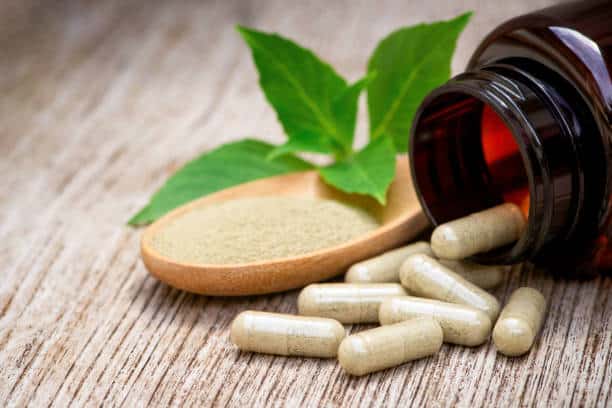
- Crushed leaf / plain powder — dried, ground leaf; closest to the traditional material, though potency varies by batch, source, and processing.
- Extracts — the leaf processed to concentrate the alkaloids, sold as liquid “shots,” powders, or gummies, often many times stronger than plain leaf.
- Enriched or semi-synthetic 7-OH products — the newest and most concerning category, specifically concentrated for 7-hydroxymitragynine, the far more potent mu-opioid alkaloid. They’re marketed as “kratom” but are pharmacologically much closer to a strong opioid. This is the category the FDA moved to schedule in 2025.
The human cost isn’t abstract. A man once approached me at the gym, described his tremendous back pain, and told me how much kratom had helped — what did I think? I told him gently that he was gambling with his life, and that I’d help him find another way; he had no idea, and said he wouldn’t touch it again. Around the same time, a friend told me about someone she knew who died in his thirties while taking kratom. So is it the plant, or what we in the West do to it? I believe it’s largely the latter — and it’s why I won’t recommend kratom to anyone right now.
Safer Natural Pain Relief, Starting With the Night
Which plants I reach for depends entirely on the type of discomfort, and I usually formulate a custom blend, because everyone is different. Several of these are used in low doses or with real caution. Since we’re talking about the up-at-night reader, let’s start where the loop lives: sleep and the gut.
Sedatives to quiet the nervous system: wild lettuce (Lactuca virosa), California poppy (Eschscholzia californica), hops (Humulus lupulus), valerian (Valeriana officinalis, sedating for most, though excitatory for some), and kava kava (Piper methysticum, which may spark wakefulness before its sedative side settles in).
Digestive pain and bloating: chamomile (Matricaria chamomilla), catnip (Nepeta cataria), and meadowsweet (Filipendula ulmaria) — all gentle enough to ease a restless gut and help you settle.
Mild to moderate pain: California poppy (Eschscholzia californica) again earns its place, calming and pain-easing at once.
From there, I match the plant to the pain:
Lower back pain: mullein root (Verbascum thapsus), black cohosh (Actaea racemosa).
Neck, jaw, and shoulder pain: skullcap (Scutellaria lateriflora), blue vervain (Verbena hastata), kava kava (Piper methysticum).
Menstrual pain: silk tassel (Garrya elliptica), cramp bark (Viburnum opulus), lobelia (Lobelia inflata), meadowsweet (Filipendula ulmaria), black haw (Viburnum prunifolium), ginger (Zingiber officinale).
Nerve pain: St. John’s wort (Hypericum perforatum), lemon balm (Melissa officinalis), black cohosh (Actaea racemosa), Jamaica dogwood (Piscidia piscipula, syn. Piscidia erythrina — potent, so respect the dose), devil’s claw (Harpagophytum procumbens).
Joint pain: white willow (Salix alba), devil’s claw (Harpagophytum procumbens, for osteoarthritis), turmeric (Curcuma longa).
Headaches: topical oils in a carrier if you tolerate aromas are great on the temples and sometimes a tea, such as lavender (Lavandula angustifolia), peppermint (Mentha × piperita), Rose (Rosa spp.), Basil (Ocimum basilicum), Rosemary (Salvia rosmarinus), Ginger (Zingiber officinale).
Injury pain: arnica (Arnica montana), applied at the site.
One plant I deliberately leave out: Boswellia (Boswellia serrata). Despite its real pain-relieving properties, the genus is under serious ecological threat (research in Nature Sustainability documents the population collapse of Boswellia papyrifera, the main frankincense source, with production projected to halve within two decades: Frankincense in peril). Sustainability is part of good herbalism. And remember: this list isn’t exhaustive, and many plants belong in more than one category.
When the Pain Outlives the Injury
If your nighttime pain has outlasted the injury that caused it, one non-herbal option is worth knowing. Pain Reprocessing Therapy (PRT) is built on the idea that some long-lasting pain is a false alarm: the brain keeps generating real pain signals after tissue has healed. Using techniques like “somatic tracking,” PRT helps the brain reinterpret those sensations as safe rather than threatening, breaking the fear-pain cycle. It’s meant for brain-generated (neuroplastic) pain, not active injury, so ruling out physical causes first is essential. A randomized controlled trial in JAMA Psychiatry found strong, durable relief for chronic back pain: PRT clinical trial.
The Bottom Line
If you’re awake tonight, caught in the loop of pain, bloating, and sleeplessness, real natural pain relief exists, but it isn’t a concentrated opioid sold at a gas station. Work with a qualified herbalist or clinician, respect the dose, and remember that “natural” and “safe” don’t always carry the same meaning. If you are looking for individualized support to support sleep and natural pain relief, check out my Root 2 Rise Reset Program
This article is for educational purposes and is not medical advice. Always consult a qualified healthcare provider before starting any herb, especially alongside prescription medications.
![Melanie [Last Name], Clinical Herbalist, Wellness Coach, Speech Pathologist](https://root2risewellness.org/wp-content/uploads/2025/10/640970d80283f12f38921c8d-1.webp)
Melanie is a Clinical Herbalist, Integrative Nutrition Health Coach (INHC), and licensed Speech Pathologist ( MS, CCC -SLP). Through her blog, she educates and empowers others, making holistic health simple, practical, and grounded in science. When she isn’t working with clients, you’ll find her gathering wild plants, cooking nourishing food, or dancing up a storm.